Full backs & large designs

Jacket Back and Full Back Embroidery Digitizing

Jacket back digitizing prepares large designs, up to 15 inches wide, for full backs on jackets, hoodies, work coats and club vests. We sequence the design zone by zone so fabric pull doesn't build up, and supply a stitch count and run-time estimate so you can price the job. Pricing is per design, not per 1,000 stitches, and you see it before work starts.

Designs up to 15 in wide
Stitch count and run-time estimate with every file
Zone-by-zone sequencing
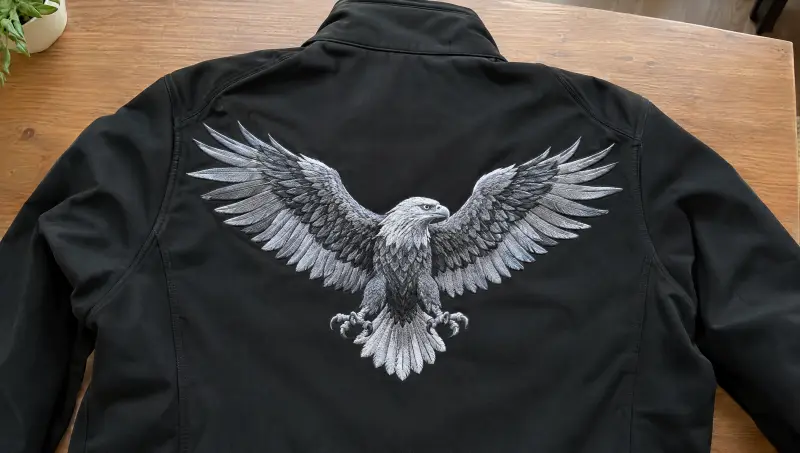
The back of a black softshell jacket with a large embroidered eagle Illustrative photo
Digitizing since 2015
Send your full back design
Built so registration holds to the last color
From $18 per design
Zone-by-zone sequencing for large areas
Staged underlay sized to the fill coverage
Estimated stitch count and run time supplied

Free quote, nothing to pay now. Need rush, formats or notes? Use the full form

15 in
Maximum design width
25–60k
Typical full-back stitch count
~8 in
Solid coverage where appliqué helps
Unlimited
Revisions, no time limit
4–8h
Standard delivery
At a glance

Jacket back digitizing specs

What it isA large-area embroidery file for full backs, planned so fabric pull doesn't accumulate across the design
GarmentsWork jackets, hoodies, varsity jackets, club vests, softshells, fleece and canvas coats
Design sizeUp to 15 in wide; your hoop or frame sets the practical limit
Typical stitch countRoughly 25,000–60,000 stitches depending on fill coverage and detail
Included with the fileEstimated stitch count and run time, stitch simulation preview
Embroidery or appliquéAbove about 8 in of solid coverage, consider appliqué for large areas
Files deliveredDST, PES, EXP, JEF, VP3 or your machine's format
PriceFlat rate per design, not per 1,000 stitches; rush +50%. See the price table below
TurnaroundStandard 4–8 hours · Rush 2–4 hours · Super rush 1–2 hours, 24/7
Why large areas are different

Large area is a cumulative problem

On a left chest, distortion is a rounding error. On a 14-inch jacket back it compounds: every zone you stitch pulls the fabric under the zones you have not stitched yet.

By the time a poorly planned back reaches its final color, the registration has drifted far enough to see from across the room. Lettering that started straight is bowed, and outlines no longer meet their fills.

Large backs also carry serious stitch counts, so sequencing decides whether the job makes money. That is why every file comes with a stitch count and run time; you can check your own figures in the free stitch count estimator before you quote.

If the first color of a back looks perfect and the last one is visibly off, the file was stitched in artwork order instead of being sequenced for the fabric.

What we build in
01

Zone-by-zone mapping

The design is split into zones and sequenced so each supports the next, instead of stitching in artwork order and letting distortion build up.
02

Staged heavy underlay

Large fills get layered underlay so the panel stays stable and fills look even under raking light rather than rippled.
03

Progressive pull compensation

Compensation is applied across the design, allowing for what earlier zones have already done to the fabric, so lettering stays straight.
Garments

How the garment changes a back file

GarmentWhat we plan for
Varsity jacket (wool melton body)A dense, springy body that needs underlay to keep fills from sinking; leather sleeves are handled as separate placements
Canvas work coatHeavy, stable cloth that takes full coverage; density kept honest so stitch count doesn't balloon
Hoodie / sweatshirtKnit fleece that stretches and has pile, so more underlay and careful pull compensation
SoftshellA bonded, often water-resistant fabric: keep coverage as light as the design allows, since every needle hole passes through it
Club or motorcycle vestCenter designs and top and bottom text are often ordered as separate designs so each can be sized and hooped on its own
Embroidery or appliqué?

When a full back should be appliqué

Above roughly 8 inches of solid coverage, appliqué is often the better choice. Fabric replaces most of the fill, so the stitch count and run time drop sharply and the back feels softer to wear.

We will tell you when a design is heading that way. If you prefer the appliqué route, see appliqué digitizing, which comes with a PDF cutting template for the fabric pieces.

Pricing

What jacket back digitizing costs

Flat pricing per design rather than a charge per 1,000 stitches, which matters on a 25,000–60,000 stitch back.

DesignPriceNotes
Jacket back / full back design$18Large-area file with stitch count and run-time estimate
Chest logo for the same jacket$10Built as its own file at chest size; see logo digitizing
Rush (2–4 hours)+50%Added to the base price of the design
Super rush (1–2 hours)+50%Added to the base price of the design

Flat rate per design, not per 1,000 stitches. Every price includes all machine formats, a stitch simulation preview and unlimited revisions with no time limit. Standard delivery is 4–8 hours, 24/7. Very detailed or complex backs are priced before any work starts, so you know the cost first.

Common problems

What goes wrong on big designs

Every problem on the left comes from treating a full back like a large left chest.

What goes wrong
Registration drifts across the design. Fine on the first zone, visibly off by the last.
Rippled, uneven fills. Underlay never scaled to carry the coverage.
Bowed lettering. Straight text pulled into a curve by fabric movement.
Runaway stitch counts. Fills padded well beyond what coverage needs.
Thread breaks under load. Long, dense runs with no relief planned.
How we build it
Registration held to the last color. Zone sequencing keeps the design true.
Flat, even fills. Staged underlay keeps the panel stable.
Straight lettering. Progressive compensation as the design builds.
Honest counts. Coverage without padding, estimated before you run.
Runs clean end to end. Density and pathing planned so the machine doesn't fight the file.
What to send

What we need for a full back

  • Artwork: vector (AI, EPS, PDF, SVG) is best for large designs; JPG or PNG is fine
  • Finished width in inches, up to 15 in
  • Garment and fabric: melton, canvas, fleece, softshell, twill
  • Your largest hoop or frame, so the file fits what you run
  • Thread colors or Pantone references
  • Any separate pieces, such as top and bottom text, listed as separate designs
How it works

From artwork to a back that runs clean

Send artwork, size and garment
Include your hoop size so the file is laid out for it.
We zone and sequence it
Underlay, compensation and running order planned across the whole back.
Review preview and estimate
Stitch simulation plus stitch count and run time, so you can price the job.
Hoop and run
Ask for any changes first; revisions are unlimited.
FAQs

Jacket back digitizing questions

We build designs up to 15 inches wide, which covers standard full-back placements on adult garments. Your practical limit is your hoop or frame, so tell us what you run and we size the file to it.

Most full backs fall between about 25,000 and 60,000 stitches, depending on fill coverage and detail. Every large-area file comes with an estimated stitch count and run time.

It depends on the stitch count and your machine speed. Each file comes with an estimated run time, and you can test your own speed settings in the free embroidery run-time calculator.

Cumulative fabric pull. Each area you stitch moves the fabric under the areas not yet stitched, so distortion compounds across a large design. Zone sequencing and progressive compensation in the file are what control it.

Yes. Wool melton bodies need underlay that stops fills sinking, and leather sleeves are handled as separate placements. Tell us the garment construction and we build accordingly.

Above roughly 8 inches of solid coverage, appliqué is often better: a much lower stitch count, faster run time and a softer feel. We will advise, and we digitize both.

Yes. Order the top text, center design and bottom text as separate designs, and each is sized to its own position and hooped on its own.

Each back has one flat price per design, not a charge per 1,000 stitches, including the stitch count and run-time estimate, every machine format and unlimited revisions; see the price table on this page or the full price list. Rush (2–4 hours) and super rush (1–2 hours) add 50%.

Send your back design and hoop size

We'll return a zone-sequenced file with a stitch count and run-time estimate, at a flat price per design.

Stitch count and run time supplied with the file
Honest advice when appliqué would run better
Unlimited revisions, no time limit

New registered business? Your first design is free: one Simple or Medium design at standard turnaround. How the free first design works

1
Standard: 4–8 hours
Flat price per design, 24/7
2
Rush: 2–4 hours
+50% on the base price
3
Super rush: 1–2 hours
+50% on the base price
Upload your back design →

Invoiced by Zorixo Ventures, LLC · W-9 on file

Upload artwork Call